Four Republicans join Democrats as House votes to curb Trump’s Iran war powers
The closely contested vote exposed divisions within the Republican Party while renewing debate over Congress' authority to approve extended military operations overseas.
Trump projected optimism over US-China trade ties before his Beijing trip, while American lawmakers unveiled a bipartisan bill targeting Chinese connected vehicles and auto technology.




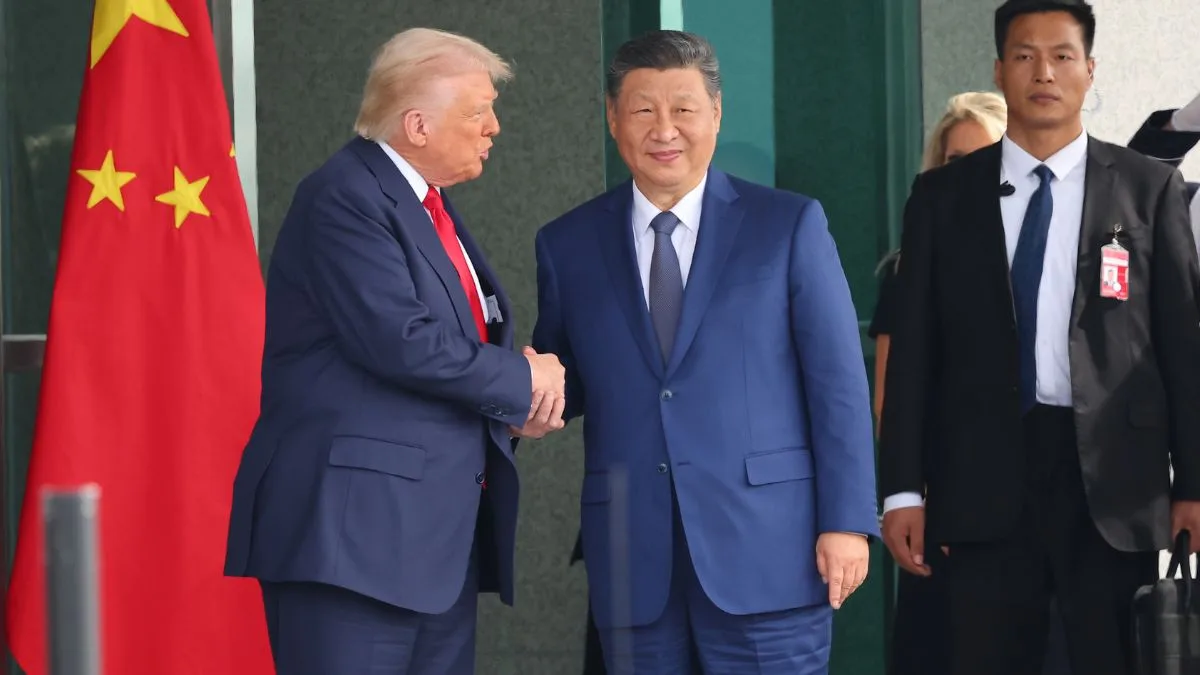
US President Donald Trump and Chinese President Xi Jinping emerge after talks at the Naraemaru reception hall inside an Air Force base in Busan on October 30, 2025. (Yonhap via IANS)
Even as US President Donald Trump signalled warmer ties with China ahead of his upcoming visit to Beijing, a fresh bipartisan push in Washington to ban Chinese-linked vehicles and auto technology has exposed the widening divide between economic engagement and national security concerns.
The contrasting developments come at a time when the United States is trying to recalibrate its trade and strategic relationship with China. While Trump has projected confidence over future business ties with Beijing, lawmakers from both parties are seeking sweeping restrictions on Chinese-connected vehicles, citing fears of surveillance, data collection and unfair industrial practices.
Advertisement
On Monday (local time), Trump said he was looking forward to meeting Chinese President Xi Jinping during his scheduled three-day visit to China.
Advertisement
“I am very much looking forward to my trip to China, an amazing Country, with a Leader, President Xi, respected by all. Great things will happen for both Countries!” Trump wrote on Truth Social.
Speaking later from the Oval Office, Trump said the US was now conducting “smart business” with China.
“We used to be taken advantage of for years with our previous presidents, but now we are doing great with China, we’re making a lot of money with China,” he told reporters.
According to a White House official quoted by ANI, more than a dozen major American business and technology leaders will accompany Trump during the visit.
The delegation is expected to include Apple CEO Tim Cook, Tesla and SpaceX chief Elon Musk, BlackRock CEO Larry Fink, Boeing CEO Kelly Ortberg, Meta executive Dina Powell McCormick, Qualcomm CEO Cristiano Amon and Visa CEO Ryan McInerney, among others.
Senior US officials said discussions between the two sides would likely focus on trade, investment and sector-specific agreements involving aerospace, agriculture and energy.
“The American people can expect the President to deliver more good deals on behalf of our country,” officials said.
Even as the White House signals economic engagement, lawmakers on Capitol Hill are moving in the opposite direction on Chinese auto technology.
A bipartisan group of US legislators has introduced the proposed “Connected Vehicle Security Act”, aimed at banning Chinese-linked connected vehicles, software and hardware from American roads.
The legislation was introduced by Republican Congressman John Moolenaar and Democratic Congresswoman Debbie Dingell.
“The American auto industry is vital for jobs, national security, and the future of America’s manufacturing base,” Moolenaar said in a statement.
He accused China of flooding global markets with low-cost vehicles and components to weaken American manufacturers.
“China cheats in every industry,” he said, while also alleging that some Chinese firms use “slave labour” to gain pricing advantages.
Dingell said the legislation was intended to prevent American manufacturing communities from suffering further decline.
“I am not interested in repeating the mistakes that hollowed out manufacturing communities across this country,” she said.
The bill proposes a ban from January 1, 2027, on the import, manufacture or sale of connected vehicles linked to what it describes as “covered foreign adversary countries”, including China, Russia, North Korea and Iran.
Restrictions on connected vehicle software would begin in 2027, while hardware-related curbs would come into force from 2030.
According to the proposed legislation, connected vehicles can gather and transmit large volumes of geolocation, operational and personal data, raising concerns about remote access and cybersecurity vulnerabilities.
Lawmakers backing the bill have also pointed to the rapid global expansion of Chinese electric vehicle makers such as BYD and battery giant CATL as part of broader concerns over supply chain dependence and industrial competition.
The legislation would empower the US Commerce Secretary to establish compliance systems and impose civil penalties of at least $1.5 million per violation.
Advertisement